

Nature: elixir of the soul – and of thought
Full sidewalks, roads packed with vehicles. Traffic chaos reverberates between buildings as far as the eye can see. At each new corner, billboards the size of trains occupy your eyes. The tired view calls for horizon. The soul begs for a little peace. Human beings have been lost in the urban environment for years. For years, he has also been looking for a bit of peace to return to nature to carry on with his days. The search for harmony with nature as a form of balance dates back to times before science. In history, poets and philosophers sought ways to explain what science now proves: Nature is the most purifying – and nourishing – thing there is for the mind, body and soul.
David Strayer, cognitive psychologist and researcher at the University of Utah, supported by his own hypotheses about the biological effects of the exercise of contemplation, obtained, using a portable electroencephalography device, clinical results that nature plays a fundamental role in quality of life. “On the third day in the bush, my senses undergo a recalibration – and I start to smell scents and hear sounds that I wasn’t able to notice before,” says Strayer.
Challenged to leave their routine and stay in contact with nature for three days, a group of students carried out a series of creativity tests. The significant increase of 50% in correct answers in the tests, when compared to those carried out within the university, did not happen by chance. According to Strayer, the effect of the three days works like cleaning the mental windshield. By slowing down our activities, we enter a contemplative state, which allows us to admire the beauty around us. Not only do we feel renewed, but our mental performance also improves.
When we are focused on everyday actions, our brain uses the prefrontal cortex, which researchers call prolonged attention. When being in a natural environment, with a free mind and a light face, our brain slows down, resting this cortex. This rest works as a break, acting in a healthy way to think.
In England, researchers from the Faculty of Medicine at the University of Exeter carried out a survey related to the mental health of 10 thousand residents, in which they found that those who lived close to green areas complained less about mental illnesses. In the Netherlands, in 2009, a team of researchers found that residents who lived less than a thousand meters from green areas had a lower incidence of 15 diseases, including depression, diabetes, migraines, asthma and heart disease.
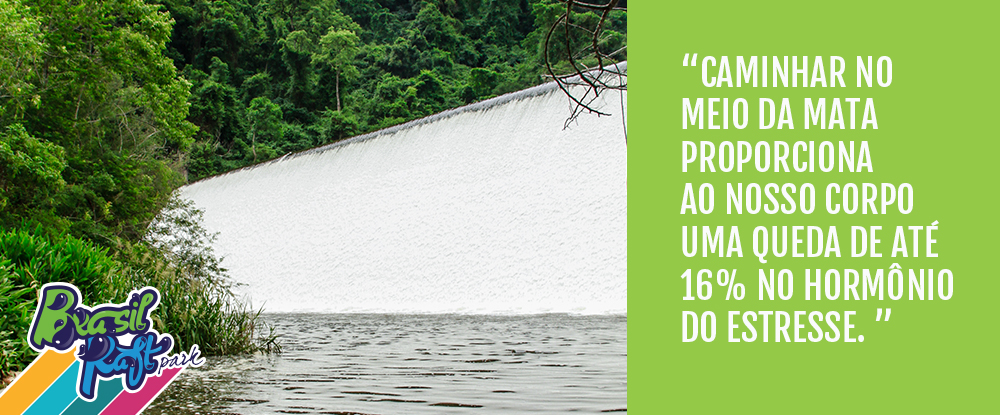
Walking in the middle of the woods gives our body a drop in stress hormones of up to 16%. “People tend to underestimate the beneficial effect of spending time in nature,” says Canadian psychologist Lisa Nisbet. “We don’t consider this as a way to increase satisfaction. In this sense, we think about other things, like going shopping or watching TV. But all our evolution took place in natural conditions. It’s very strange that we are now so disconnected.”
The path to a better quality of life may be in simply coloring the stone jungle in which we live. Turn off the TV. Go to the mall less. Do what takes your soul to a better place. Contemplating nature has a low cost. Very low. It has no contraindications, is beneficial for health and requires the simplest thing from us: allowing ourselves to do so.